
Jaw Pain, Headaches, and Neck Discomfort: Why Assessment Matters
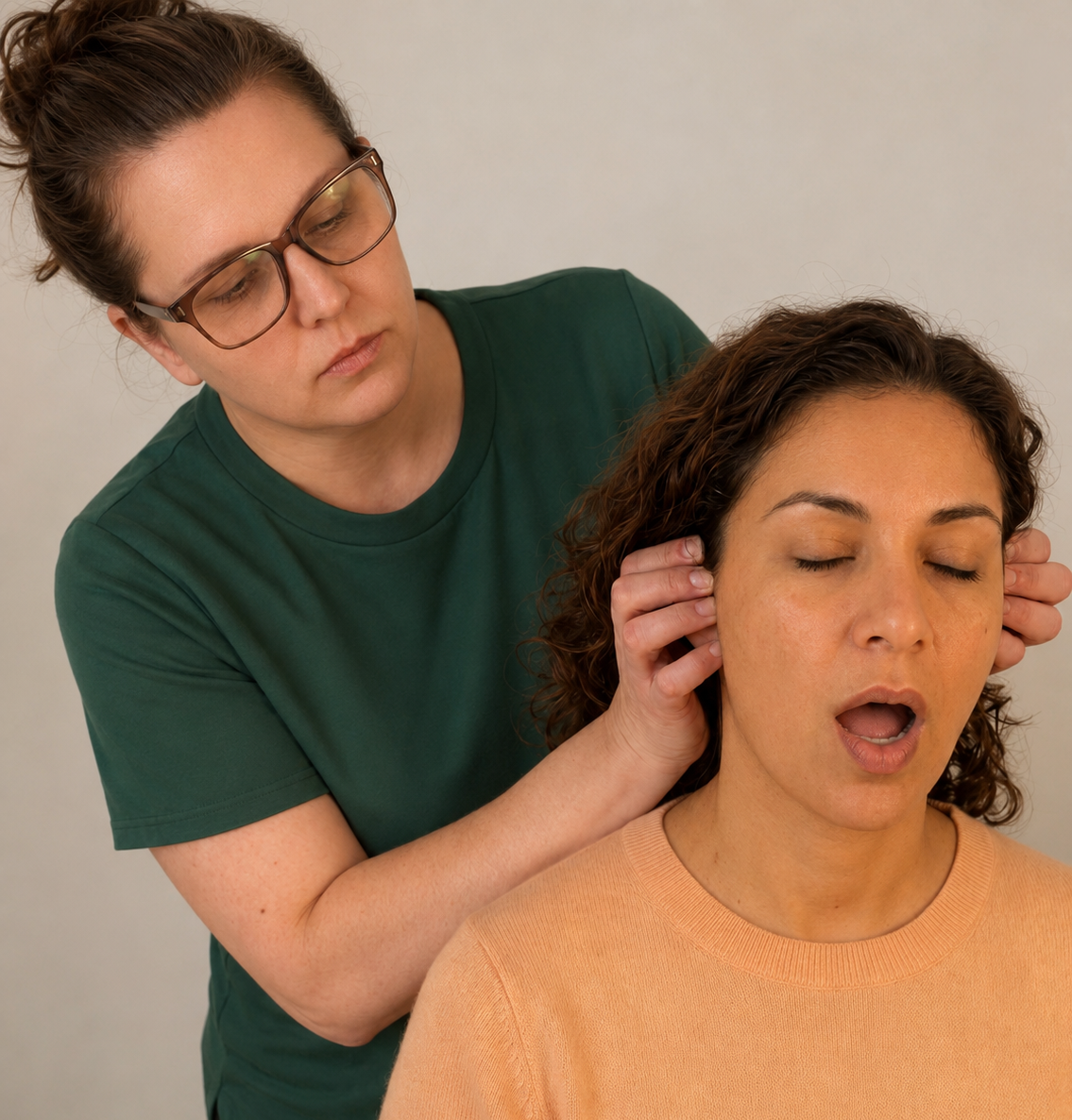
When people talk to me about jaw pain, it is rarely just one simple symptom.
Jaw discomfort can affect everyday things like eating, talking, yawning, sleeping, or getting through dental appointments. Some patients feel pain near the jaw joint. Others notice headaches, temple pain, facial discomfort, ear-area pressure, neck stiffness, tooth sensitivity, clicking, popping, clenching, or difficulty chewing.
Many people use the word “TMJ” when they are talking about jaw pain, clicking, clenching, headaches, or difficulty opening their mouth.
That makes sense. It is the term most people hear first, and it is commonly used in everyday conversation.
Technically, the TMJ is the temporomandibular joint itself. We all have two of them: one on each side of the jaw. When healthcare providers are talking about pain, movement changes, or symptoms involving the jaw joints, chewing muscles, related nerves, and surrounding tissues, the term TMD or TMJD may be used.
You do not need to know the perfect terminology before asking for help. If you tell me “I have TMJ,” I know what you mean, and we can start there.
As a Registered Massage Therapist, I do not diagnose TMD/TMJD. My role is to assess within my scope, provide appropriate manual therapy, educate patients, support therapeutic goals, and refer to dental, medical, or other healthcare providers when symptoms need further investigation.
My approach to jaw pain is assessment-based, consent-based, and collaborative.
Why assessment matters
Jaw pain can have many possible contributing factors, which is why assessment matters.
In healthcare, it is easy for symptoms to get labelled quickly. A person may say they have “TMJ,” just like someone else may say they have “sciatica,” “a pinched nerve,” or “stress tension.” Those words can be useful starting points, but they do not always tell the whole story.
As an RMT, my role is not to diagnose the cause of jaw pain. My role is to ask good questions, assess within my scope, notice when symptoms do not fit a simple pattern, provide appropriate manual therapy when it is safe to do so, and refer when dental, medical, or collaborative care may be needed.
A Massage Therapy assessment for jaw-related symptoms may include questions about your health history, dental history, headaches, neck symptoms, sleep, stress, oral habits, symptom behaviour, and what makes your discomfort better or worse.
Assessment may also include observing jaw movement, neck movement, shoulder and upper body movement, areas of pain or sensitivity, and how symptoms respond to gentle testing.
The goal is not to force the jaw to move a certain way or chase one “perfect” position. The goal is to understand what is appropriate, what needs caution, and what may need another provider’s input.
Looking beyond the painful spot
Jaw symptoms can be influenced by more than the area that hurts.
The jaw is involved in chewing, speaking, swallowing, yawning, facial expression, breathing patterns, and daily habits. It also works closely with the neck, head, shoulders, nervous system, dental structures, and overall health history.
That does not mean every jaw symptom is complicated or serious. It means we should avoid assuming.
For example, jaw discomfort may be associated with clenching or grinding, chewing mostly on one side, prolonged dental appointments, stress physiology, sleep disruption, neck involvement, previous injury, inflammatory conditions, or other health factors. Sometimes the painful side is not the only side that needs to be assessed, because both jaw joints are part of the same mandible and they work together.
This is why I look at symptom patterns, not just one sore area.
During assessment, I may ask about things like when symptoms started, what makes them better or worse, whether chewing or yawning changes the discomfort, whether headaches or ear-area symptoms are present, whether there has been recent dental work, whether the jaw clicks or locks, and whether neck movement changes symptoms.
These details help guide safer, more appropriate care. They also help identify when Massage Therapy is a reasonable part of conservative care, when treatment should be modified, and when another provider should be involved.
Common symptoms patients may notice
Jaw-related concerns can show up in different ways. Patients may notice:
* pain or discomfort near the jaw joint
* pain in the temples, cheeks, face, or around the ears
* headaches
* neck discomfort or stiffness
* clicking, popping, or grinding sounds
* difficulty opening the mouth fully
* discomfort with chewing, yawning, talking, or singing
* clenching or grinding
* morning jaw stiffness
* tooth sensitivity or pain that has been checked by a dentist
* ear pressure, ringing, buzzing, or a sense of fullness
* sinus-like pressure
* jaw fatigue
* symptoms that increase during stressful periods or after poor sleep
Not every click or pop is automatically a problem. Some jaw sounds are painless and do not always require treatment. Symptoms become more concerning when they are painful, worsening, limiting movement, affecting eating or speaking, disturbing sleep, or interfering with daily life.
What Massage Therapy may include
Massage Therapy for jaw-related symptoms may include external work around the jaw, cheeks, temples, scalp, neck, shoulders, upper back, and chest wall when appropriate and with consent.
Treatment may also include education, homecare, jaw awareness strategies, gentle movement, breathing mechanics, and discussion around habits that may be contributing to discomfort, such as clenching, grinding, chewing mostly on one side, or repeatedly “testing” the jaw.
Intra-oral Massage Therapy may be an option for some patients. This means working inside the mouth with gloves to access specific jaw muscles. It is not required, and it should only be done with clear informed consent.
Patients can pause, modify, or stop treatment at any time.
For many people, external treatment is a good place to start. Intra-oral work is simply one possible tool, not a requirement for care.
Staying within scope
It is important to be clear about what Massage Therapy can and cannot do.
As an RMT, I do not diagnose TMD/TMJD. I do not diagnose dental conditions. I do not assess or make recommendations about mouthguards, orthodontics, bite changes, or dental appliances. Those are dental and orthodontic areas of care.
I do not call myself a TMJ specialist. In Ontario, RMTs cannot claim a specialty designation. What I can say is that I have focused training and clinical interest in supporting patients with jaw, head, neck, and related symptoms within Massage Therapy scope.
My role is to provide safe, appropriate manual therapy, communicate clearly, support patient comfort and function, and work alongside other healthcare providers when collaborative care is needed.
When to involve a dentist, doctor, or other healthcare provider
Massage Therapy can be part of conservative care, but some symptoms need dental or medical assessment.
It is important to check in with a dentist, physician, or appropriate healthcare provider if you have:
* sudden jaw swelling
* fever or signs of infection
* dental pain or suspected tooth-related symptoms
* a major change in your bite
* jaw locking that does not improve
* trauma to the face, jaw, or head
* severe or worsening pain
* unexplained numbness, weakness, or neurological symptoms
* difficulty swallowing or breathing
* new or worsening ear symptoms
* symptoms that are not improving or are affecting daily function
Collaborative care is often helpful. Depending on the situation, this may include a dentist, physician, physiotherapist, oral surgeon, psychologist, sleep medicine provider, or another healthcare professional.
A conservative, patient-centred approach
Jaw pain can feel confusing, especially when symptoms involve the head, neck, face, ears, and teeth. It can also be discouraging when patients have been told “everything looks fine” but they still have pain or discomfort.
My approach is to listen first, assess carefully, stay within scope, and work with the information your body and your history are giving us.
Massage Therapy is not about forcing the jaw into place or promising a quick fix. It is about supporting pain, tension, stiffness, movement, comfort, and function in a way that respects your body, your nervous system, your consent, and your therapeutic goals.
If you are experiencing jaw pain, headaches, neck discomfort, or symptoms that may be related to TMD/TMJD, you are welcome to bring it up during your appointment or book an assessment-focused treatment.

Comments